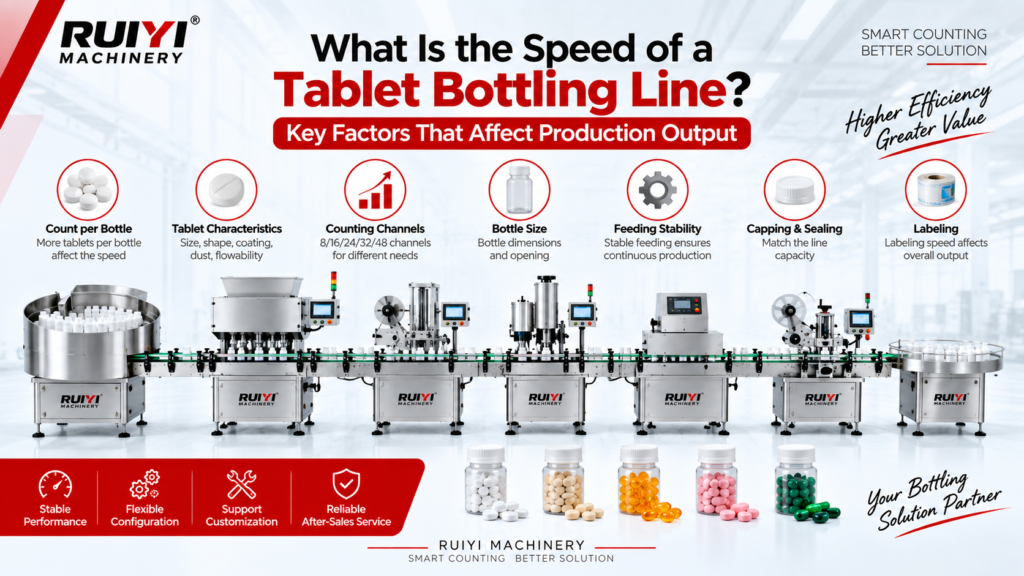
A complete automatic bottling line connects multiple packaging machines into one continuous production process. For tablets, capsules and other suitable solid products, a typical line can automatically handle bottle unscrambling, product counting, desiccant inserting, capping, induction sealing, labeling and bottle collection.
Instead of operating each machine separately, the equipment is connected by conveyors and coordinated according to the production requirements. This reduces manual handling between packaging stages and creates a more continuous bottling process.
However, not every production line requires exactly the same machines. The correct configuration depends on the product, bottle, cap, required count per bottle, production capacity and packaging requirements.
This guide explains how a complete automatic bottling line works, what each machine does and what information buyers should prepare before selecting a line.
Table of Contents
What Is a Complete Automatic Bottling Line?
A complete automatic bottling line is an integrated packaging system that combines several machines to complete multiple bottling processes automatically.
For tablet and capsule bottling applications, a typical configuration may include:
- Automatic Bottle Unscrambler
- Electronic Counting Machine
- Desiccant Inserter
- Automatic Capping Machine
- Induction Sealing Machine
- Automatic Labeling Machine
- Conveyors
- Bottle Collection Turntable
Each machine performs a specific packaging operation.
The exact configuration can be adjusted according to the customer’s product and packaging requirements. For example, some projects may not require a desiccant inserter, while others may require additional inspection, rejection or bottle-handling equipment.
For this reason, a complete bottling line should be configured around the actual packaging process rather than treated as one fixed combination of machines.
How Does a Complete Automatic Bottling Line Work?
The basic workflow is straightforward:
Bottle Unscrambling → Electronic Counting → Desiccant Inserting → Capping → Induction Sealing → Labeling → Bottle Collection
Empty bottles first enter the production line and are organized into the correct orientation. The electronic counting machine then counts the required quantity of product into each bottle.
If required, a desiccant is inserted before the bottle enters the capping process. After capping, the bottle can pass through induction sealing and labeling before being transferred to the end of the line.
Now let’s look at each stage in more detail.
Step 1: Automatic Bottle Unscrambling
The first stage of many automatic bottling lines is bottle unscrambling.
Empty bottles may enter the system in an unordered condition. The automatic bottle unscrambler organizes them and supplies them to the conveyor in the correct orientation.
This provides a continuous bottle supply for downstream equipment.
Why Is Stable Bottle Supply Important?
The counting machine and other packaging equipment depend on bottles arriving consistently.
If bottles are supplied irregularly, downstream machines may need to wait for bottles or stop temporarily.
The bottle unscrambler therefore plays an important role in maintaining a continuous production process.
When selecting a bottle unscrambler, manufacturers should provide information about:
- Bottle material
- Bottle height
- Bottle diameter or width
- Bottle shape
- Bottle opening
- Required production capacity
Different bottle shapes and dimensions may require different adjustments or machine configurations.
Step 2: Electronic Counting and Filling
After bottle unscrambling, the bottles move to the electronic counting machine.
This is one of the core machines in a tablet or capsule bottling line.
Products are fed into the counting system, separated and detected before the required quantity is dispensed into each bottle.
Depending on the production requirement, different counting-machine configurations can be considered, including:
- 8-channel
- 16-channel
- 24-channel
- 32-channel
- 48-channel
The correct number of channels should be selected according to the actual application rather than simply choosing the machine with the most channels.
What Products Can Be Counted?
Depending on product characteristics and machine configuration, electronic counting equipment can be used for suitable solid products such as:
- Tablets
- Hard capsules
- Softgel capsules
- Certain gummies
- Other countable solid products
Product dimensions, shape, surface characteristics, dust, stickiness and flowability can affect feeding and counting behavior.
For unusual products, sample testing is recommended before confirming the final equipment configuration.
Step 3: Desiccant Inserting
After counting and filling, some products require a desiccant inside the bottle.
A desiccant inserter automatically feeds and inserts the desiccant into the bottle before capping.
This process is commonly used when the packaging design requires moisture-control material inside the bottle.
Different desiccant formats may require different feeding mechanisms, so buyers should confirm the actual desiccant specification with the equipment supplier.
Is a Desiccant Inserter Always Required?
No.
Whether a desiccant inserter is needed depends on the product and packaging requirements.
If the product does not require a desiccant, this machine can be omitted from the production line.
This is one example of why a complete automatic bottling line should be configured according to the actual packaging process rather than using unnecessary equipment.
Step 4: Automatic Capping
After the product and any required desiccant have been inserted, the bottle moves to the automatic capping machine.
The capping system places or tightens the cap according to the bottle and cap configuration.
Stable bottle positioning is important during this process because the bottle and cap must remain properly aligned.
What Information Is Needed for Capping?
Before selecting the capping machine, provide:
- Bottle dimensions
- Bottle photos or drawings
- Cap dimensions
- Cap photos
- Cap type
- Bottle and cap samples when possible
- Required production capacity
The capping configuration should be selected based on the actual bottle and cap rather than the bottle alone.
Step 5: Induction Sealing
After capping, bottles can pass through an induction sealing machine when an induction foil seal is required.
The induction sealing process creates a seal at the bottle opening using a compatible cap liner and container system.
The purpose of this stage depends on the packaging design and product requirements.
What Affects Induction Sealing?
Important factors include:
- Bottle material
- Bottle opening
- Cap and liner
- Container dimensions
- Conveyor speed
- Sealing-machine configuration
The bottle, cap and foil liner should therefore be evaluated together when selecting an induction sealing solution.
Depending on production conditions, different cooling configurations may also be considered for the sealing equipment.
Step 6: Automatic Bottle Labeling
After sealing, bottles can move to an automatic labeling machine.
For round bottles, a round bottle labeling machine can automatically apply labels as bottles move through the production line.
Labeling requirements can vary significantly depending on the bottle and label.
Important information includes:
- Bottle dimensions
- Bottle shape
- Label width
- Label length
- Label material
- Label roll specifications
- Label position
Providing actual bottle and label samples can help confirm the appropriate labeling configuration.
Step 7: Bottle Collection
At the end of the production line, finished bottles need to be collected or transferred to the next packaging stage.
A bottle collection turntable can provide temporary accumulation and make it easier for operators to collect finished bottles.
Depending on the factory process, bottles may also continue to other equipment instead of being manually collected.
The end-of-line configuration should therefore be planned together with the customer’s overall packaging process.
How Are the Machines Connected?
In a complete automatic bottling line, the individual machines are normally connected by conveyors.
However, physical connection alone is not enough.
The operating rhythm of the machines must also be coordinated.
For example, if the counting machine stops temporarily, downstream equipment should not continue receiving bottles without control. Likewise, if a downstream machine cannot accept additional bottles, upstream bottle flow may need to be controlled.
This is why line integration should consider the complete process rather than simply placing several standalone machines next to each other.
What Determines the Capacity of a Complete Bottling Line?
A common mistake is to judge the production capacity of the complete line only by the counting machine.
In reality, final line output can be influenced by multiple factors, including:
- Product characteristics
- Quantity per bottle
- Bottle dimensions
- Bottle opening
- Counting-machine configuration
- Product feeding stability
- Bottle supply
- Capping requirements
- Sealing requirements
- Labeling requirements
- Conveyor operation
- Upstream and downstream coordination
The slowest or most restrictive stage can affect the usable output of the complete line.
Therefore, buyers should provide a target production requirement for the complete automatic bottling line, not only request the maximum speed of each individual machine.
Does More Counting Channels Mean a Faster Bottling Line?
Not automatically.Learn more about how to choose the right electronic counting machine channels for different production requirements.
A higher-channel electronic counting machine can provide additional counting capacity, but the rest of the production line must be able to support the required output.
For example, increasing counting capacity will not necessarily increase final production output if bottle supply, capping or another downstream process becomes the bottleneck.
The product itself also matters.
Products that feed easily may behave differently from dusty tablets, oily softgels or sticky gummies.
The number of counting channels should therefore be selected together with the complete line configuration.
Can One Bottling Line Handle Different Bottle Sizes?
A bottling line can often be configured to accommodate multiple compatible bottle sizes, but changeover requirements depend on the machines and the difference between the bottles.
When changing bottles, operators may need to adjust:
- Conveyor guides
- Bottle positioning components
- Counting-machine settings
- Filling positions
- Capping components
- Labeling settings
- Other bottle-handling parts
Large differences in bottle dimensions or shapes may require additional parts or a different configuration.
For this reason, buyers who plan to use several bottle sizes should provide information about all intended bottles before the production line is finalized.
Can One Line Handle Different Tablets and Capsules?
Depending on the actual products, one electronic counting line may be configured for multiple compatible tablets or capsules.
However, different products can require different feeding and machine settings.
Important differences include:
- Product diameter
- Length
- Thickness
- Shape
- Surface condition
- Dust level
- Flowability
- Stickiness or oil
A standard hard capsule, for example, may feed differently from a softgel or gummy.
If multiple products will be produced on the same line, provide samples or specifications for each important product during the equipment-selection stage.
Can Gummies Be Packed on an Automatic Bottling Line?
Suitable gummies can be counted and bottled automatically, but gummy products require additional evaluation because their characteristics vary significantly.
Important factors include:
- Stickiness
- Sugar coating
- Oil
- Shape
- Dimensions
- Flexibility
- Tendency to stick together
- Feeding behavior
It is better to test the actual gummy than to assume that every gummy product will behave the same way.
Sample testing helps determine whether the feeding and counting configuration is suitable for the product.
Standalone Machines vs. a Complete Automatic Bottling Line
Some manufacturers do not need a complete line.
If a factory already has bottle handling, capping, sealing or labeling equipment, adding only an electronic counting machine may be sufficient.
A complete line becomes more relevant when the manufacturer wants multiple packaging stages to operate as one coordinated process.
A Standalone Machine May Be Suitable When:
- Existing packaging equipment is already available
- Production volume is relatively limited
- Operators manually transfer bottles between processes
- Only one packaging stage needs to be automated
A Complete Bottling Line May Be Suitable When:
- Multiple packaging stages need automation
- Continuous bottle handling is required
- Production capacity is increasing
- Manual transfer between machines should be reduced
- A new bottling project is being planned
The best choice depends on the existing factory process and future production requirements.
How Do You Choose the Right Complete Automatic Bottling Line?
Choosing the right line starts with the product and packaging requirements.
Instead of asking a supplier only for “a tablet bottling line,” provide detailed project information.
1. Identify the Product
Specify whether you need to package:
- Tablets
- Capsules
- Softgels
- Gummies
- Other suitable solid products
Provide dimensions, photos and samples when possible.
2. Confirm the Quantity per Bottle
The number of products required in each bottle directly affects the counting process and production calculation.
Provide all required count quantities if several package sizes will be produced.
3. Provide Bottle Information
Send:
- Bottle height
- Bottle diameter or width
- Bottle opening diameter
- Bottle material
- Bottle photos
- Bottle drawings if available
If several bottle sizes will be used, provide information for each one.
4. Provide Cap Information
The capping system must match the bottle and cap.
Provide cap dimensions, photos and samples whenever possible.
5. Confirm Desiccant Requirements
If a desiccant is required, provide its dimensions and packaging format.
If no desiccant is required, the corresponding machine may not be necessary.
6. Confirm Sealing Requirements
Tell the supplier whether induction sealing is required and provide information about the bottle, cap and liner.
7. Provide Label Specifications
For automatic labeling, provide bottle and label specifications.
8. Define Required Production Capacity
Instead of simply requesting the “fastest machine,” provide the actual target in bottles per minute or another relevant production requirement.
This makes equipment selection more meaningful.
What Information Should You Send to a Bottling Line Manufacturer?
Before requesting a detailed quotation, prepare as much of the following information as possible:
- Product type
- Product name
- Product dimensions
- Product photos or videos
- Product samples
- Quantity per bottle
- Bottle dimensions
- Bottle opening diameter
- Bottle photos or drawings
- Bottle samples
- Cap dimensions and type
- Cap samples
- Desiccant specification if required
- Induction sealing requirements
- Label specifications
- Required production capacity
- Available factory space
- Power supply requirements
- Existing equipment that needs to connect with the new line
The more complete the information, the easier it is for the manufacturer to evaluate a suitable configuration.
Why Is Sample Testing Important?
Specifications are useful, but they do not always show exactly how a product behaves during automatic feeding.
Two products with similar dimensions may still have different surface characteristics or flow behavior.
Sample testing can help evaluate:
- Feeding stability
- Product separation
- Counting behavior
- Bottle filling
- Bottle compatibility
- Changeover requirements
It is particularly useful for unusual tablets, softgels, gummies or other products with challenging feeding characteristics.
Frequently Asked Questions
What machines are included in a complete automatic bottling line?
A typical solid-product bottling line can include a bottle unscrambler, electronic counting machine, desiccant inserter, automatic capping machine, induction sealing machine, labeling machine, conveyors and bottle collection equipment. The exact configuration depends on the packaging requirements.
How does a complete automatic bottling line work?
Empty bottles are organized and supplied to the conveyor, products are automatically counted into bottles, and additional processes such as desiccant inserting, capping, induction sealing and labeling are completed in sequence. Finished bottles are then collected or transferred to the next packaging stage.
What products can be packed on an automatic bottling line?
Depending on the machine configuration and actual product characteristics, suitable tablets, hard capsules, softgel capsules, certain gummies and other countable solid products can be handled.
Is a desiccant inserter necessary for every bottling line?
No. A desiccant inserter is only required when the product and packaging design call for a desiccant inside the bottle.
Can a complete bottling line handle different bottle sizes?
Compatible bottle sizes can often be handled through machine adjustments or change parts. The actual changeover requirements depend on the difference between the bottle dimensions and the equipment configuration.
Can the same bottling line package tablets and capsules?
Depending on the actual products, one line may be configured for different compatible tablets and capsules. Feeding and machine settings may need to be adjusted when products change.
How do I determine the required counting-machine channels?
The appropriate 8, 16, 24, 32 or 48-channel configuration depends on the product, bottle, count quantity, required production capacity and complete line design. More channels do not automatically mean a better solution.
What determines the speed of a complete automatic bottling line?
Final output depends on the complete process, including product feeding, count quantity, bottle supply, counting configuration, capping, sealing, labeling and line coordination. It should not be determined by one machine alone.
Should I send product samples before ordering?
For products with unusual dimensions, shapes, dust, stickiness, oil or other special characteristics, sample testing is recommended whenever possible. Bottle, cap and label samples can also help confirm equipment compatibility.
Can existing machines be connected to a new bottling line?
It may be possible, depending on the existing equipment, working height, control requirements, conveyor arrangement and production capacity. The existing machines should be evaluated before the final line configuration is confirmed.
Building the Right Bottling Solution
A complete automatic bottling line is more than a collection of individual machines. The bottle unscrambler, electronic counting machine, desiccant inserter, capping machine, induction sealer, labeling machine and conveyors need to work together according to the same production requirement.
The right configuration starts with understanding the actual product and packaging process.
Before selecting equipment, determine what products will be counted, how many pieces are required per bottle, which bottles and caps will be used, whether desiccant and induction sealing are required, and what production capacity is expected.
RUIYI MACHINERY provides standalone counting and packaging equipment as well as complete bottling solutions for different production requirements.
For a project evaluation, send your product specifications, bottle and cap information, count quantity, required capacity and any available samples or videos. This information can be used to evaluate a suitable machine and line configuration.
WhatsApp: +86 138 6815 9610
Email: ruiyi@ruiyimech.com