Tablet bottling line speed is not determined by a single fixed number. The actual production output of an automatic tablet bottling line depends on several factors, including the number of tablets per bottle, tablet characteristics, electronic counting machine configuration, bottle dimensions, feeding stability and the capacity of connected packaging equipment.
For example, a line filling a relatively small quantity of tablets into each bottle may operate differently from the same line filling a much larger quantity. A standard tablet with stable feeding characteristics may also behave differently from a dusty, irregular or difficult-to-feed product.
This is why buyers should be careful when comparing bottling lines based only on a stated “maximum bottles per minute.”
A more useful approach is to evaluate the complete production application.
This guide explains what determines tablet bottling line speed, where production bottlenecks can occur and what information manufacturers should provide when requesting a realistic capacity evaluation.
Table of Contents
How Fast Is a Tablet Bottling Line?
There is no single production speed that applies to every tablet bottling line.
Actual output depends on the combination of the product, bottle, quantity per bottle, counting equipment and downstream packaging processes.
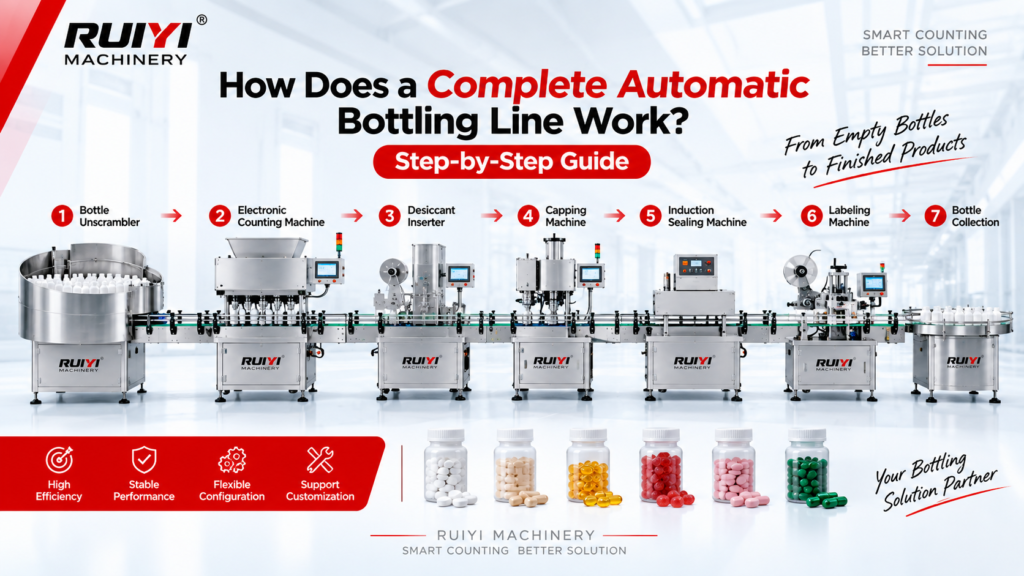
A typical automatic tablet bottling process may include:
- Bottle unscrambling
- Electronic counting and filling
- Desiccant inserting
- Automatic capping
- Induction sealing
- Automatic labeling
- Bottle collection
Each stage has its own operating capacity.
The usable production output of the complete line depends on how these machines work together under actual production conditions.
Therefore, when a supplier provides a capacity estimate, buyers should ask what product, bottle and count quantity were used as the basis for that estimate.
What Determines Tablet Bottling Line Speed?
Several factors can affect the final output of an automatic bottling line.
The most important include:
- Quantity per bottle
- Tablet dimensions and shape
- Tablet surface characteristics
- Product feeding stability
- Number of counting channels
- Bottle size and bottle opening
- Bottle supply
- Capping requirements
- Induction sealing
- Labeling requirements
- Conveyor operation
- Coordination between machines
These factors should be evaluated together rather than separately.
- 1. Count Quantity per Bottle
The required quantity of tablets in each bottle is one of the most important factors affecting production output.
Consider two packaging requirements using the same tablet and bottle.
One bottle requires a relatively small quantity of tablets, while another requires a much larger quantity.
The counting machine needs more counting time to complete the larger count, assuming other conditions remain comparable.
Therefore, asking only:
“How many bottles per minute can this machine produce?”
does not provide enough information.
A more useful question is:
“What production output can this line achieve with my product, my bottle and my required quantity per bottle?”
Why Should Buyers Provide Every Count Quantity?
Some manufacturers package the same tablet in several bottle configurations.
For example, the same product may be sold in different quantities depending on the market or package size.
If several count quantities will be used, provide all of them to the machine supplier.
This allows the supplier to evaluate different production scenarios instead of calculating capacity based on only one package.
- 2. Tablet Size and Shape
Tablet dimensions and shape can influence feeding behavior.
Round tablets, oblong tablets and other shapes do not necessarily move through a feeding system in exactly the same way.
Important product information includes:
- Diameter
- Length
- Width
- Thickness
- Shape
- Weight
- Surface characteristics
Consistent product dimensions generally make feeding behavior easier to evaluate.
Unusual shapes may require additional testing before the final machine configuration is confirmed.
Does a Smaller Tablet Always Mean Faster Production?
Not necessarily.
Physical size is only one factor.
A smaller tablet may still produce significant dust, overlap during feeding or behave irregularly in the feeding system.
Production capacity should therefore be evaluated using the actual product rather than product size alone.
- 3. Tablet Surface Characteristics
Surface characteristics can also influence tablet bottling line speed.
Some tablets feed smoothly and separate consistently, while others may create more friction, dust or irregular movement.
Factors to consider include:
- Surface coating
- Dust level
- Friction
- Product consistency
- Tendency to overlap
- Flowability
If products do not separate consistently before entering the counting area, simply increasing machine speed may reduce stable operation rather than increase usable output.
For products with unusual characteristics, sample testing can provide a more realistic evaluation.
- 4. Product Feeding Stability
An electronic counting machine needs a stable supply of separated products.
The feeding system moves products toward the counting and detection area. If product flow becomes irregular, the machine may need to operate at settings that maintain better separation.
This is why feeding stability is closely related to production capacity.
What Can Affect Feeding Stability?
Possible factors include:
- Product shape
- Product dimensions
- Dust
- Surface friction
- Feeding settings
- Product accumulation
- Vibration settings
- Product separation
A high nominal machine speed is not useful if the product cannot feed reliably at that operating condition.
The objective is therefore not simply to run the machine as fast as possible, but to achieve stable and repeatable production.
- 5. Number of Electronic Counting Machine Channels
Electronic counting machines are available in different channel configurations.
Depending on the equipment range and project requirements, configurations may include:
- 8 channels
- 16 channels
- 24 channels
- 32 channels
- 48 channels
Additional counting channels can provide greater counting capacity when the product and complete production line support it.
However, the relationship between counting channels and final output is not as simple as:
More channels = proportionally more bottles per minute.
Actual performance still depends on product feeding, quantity per bottle, bottle handling and downstream equipment.
Does a 48-Channel Counter Always Make the Line Faster?
No.
A 48-channel electronic counting machine provides a higher-channel configuration, but it does not automatically guarantee that the complete production line will achieve higher usable output.
For example, if the counting machine can supply filled bottles faster than the capping machine can process them, the capping stage may become the bottleneck.
The same situation can occur with bottle supply, sealing, labeling or another part of the line.
A higher-channel counting machine is most useful when the complete production system is designed to support the required capacity.
This is why counting-machine channel selection should be based on the complete production requirement.
- 6. Bottle Size and Bottle Opening
Bottle specifications can influence the filling process.
Important dimensions include:
- Bottle height
- Bottle diameter or width
- Bottle opening diameter
- Bottle shape
- Bottle material
The bottle opening is particularly important because counted tablets need to enter the bottle smoothly.
A relatively narrow bottle opening combined with a larger product may require a different filling arrangement from a wider bottle.
Bottle stability on the conveyor should also be considered.
Tall, narrow or unusually shaped bottles may require additional attention to guide adjustment and positioning.
- 7. Bottle Unscrambler Capacity
Before tablets can be counted, empty bottles must reach the counting machine.
In a complete automatic line, an automatic bottle unscrambler can organize empty bottles and feed them onto the conveyor.
If bottle supply cannot keep up with the counting process, the counting machine may have to wait for bottles.
Therefore, bottle unscrambling capacity should be matched to the required line output.
The goal is to maintain a stable bottle supply rather than allow repeated shortages or excessive bottle accumulation.
- 8. Desiccant Inserting
Some tablet bottling projects require a desiccant inside each bottle.
When a desiccant inserter is included, its operating capacity becomes another part of the line calculation.
The desiccant format, dimensions and feeding behavior should be considered.
Not every tablet bottling project requires this machine.
If no desiccant is required, the process can be omitted from the line configuration.
- 9. Automatic Capping
After counting and any required desiccant insertion, bottles move to the capping process.
The automatic capping machine must handle the actual bottle and cap consistently at the required production rate.
Important factors include:
- Cap type
- Cap diameter
- Cap height
- Bottle dimensions
- Bottle stability
- Cap feeding
- Tightening requirements
A capping system should be evaluated using the actual bottle and cap whenever possible.
If capping cannot operate consistently at the required output, increasing the speed of the counting machine will not increase final line output.
- 10. Induction Sealing
When foil sealing is required, bottles can pass through an induction sealing machine after capping.
Sealing performance depends on the packaging system, including:
- Bottle material
- Cap
- Foil liner
- Bottle opening
- Conveyor speed
- Sealing configuration
The induction sealer should therefore be selected to match both the packaging material and required line capacity.
- 11. Automatic Labeling
Labeling is another downstream process that can affect production flow.
For round bottles, an automatic round bottle labeling machine can apply labels continuously as bottles move through the line.
The labeling application depends on:
- Bottle size
- Bottle shape
- Label dimensions
- Label material
- Label position
- Required production output
If the labeling process is slower than the upstream machines, bottle accumulation may occur before the labeling machine.
This is why the entire line needs balanced capacity.
Which Machine Determines the Speed of a Tablet Bottling Line?
There is not always one specific machine that determines the output.
Instead, the effective tablet bottling line speed is influenced by the stage that becomes the limiting factor under the actual production conditions.
This is sometimes described as the production bottleneck.
For one project, electronic counting may be the main capacity limitation.
For another, bottle handling or capping may be more restrictive.
For a different product, feeding stability may determine how quickly the line can operate consistently.
The bottleneck can therefore change when the product, bottle or count quantity changes.
Why Maximum Machine Speed Can Be Misleading
Machine specifications often include a maximum or reference production capacity.
This information can be useful for initial comparison, but it should not be treated as a guaranteed output for every product.
The actual application may be different from the conditions used to determine the reference capacity.
For example, changes in:
- Tablet size
- Tablet shape
- Quantity per bottle
- Bottle opening
- Feeding behavior
- Downstream equipment
can change the final production output.
For B2B equipment selection, a realistic application-based capacity estimate is generally more useful than comparing maximum numbers alone.
How Should Tablet Bottling Line Capacity Be Calculated?
A useful capacity evaluation starts with the required finished-bottle output.
The manufacturer should then work backward through the production process.
Step 1: Define the Required Finished Output
Determine the required number of finished bottles over a given production period.
This gives the project a clear production target.
Step 2: Confirm the Count per Bottle
Specify exactly how many tablets are required in each bottle.
If several package sizes are required, provide each count quantity.
Step 3: Confirm Product Characteristics
Provide tablet:
- Dimensions
- Shape
- Photos
- Surface information
- Samples when possible
Step 4: Confirm Bottle and Cap Specifications
Provide:
- Bottle dimensions
- Bottle opening
- Bottle material
- Cap dimensions
- Bottle and cap photos
- Samples when available
Step 5: Identify Every Required Packaging Process
Confirm whether the project requires:
- Bottle unscrambling
- Electronic counting
- Desiccant inserting
- Capping
- Induction sealing
- Labeling
- Bottle collection
- Other additional processes
Step 6: Evaluate the Complete Line
The supplier can then evaluate whether each machine can support the required production target and recommend an appropriate line configuration.
How Can Tablet Bottling Line Speed Be Improved?
Improving production output does not always require replacing the counting machine with a larger model.
The correct solution depends on the actual bottleneck.
Possible areas to evaluate include:
- Improving product feeding stability
- Optimizing machine settings
- Selecting an appropriate counting-channel configuration
- Improving bottle supply
- Optimizing conveyor flow
- Matching downstream machine capacity
- Reducing unnecessary bottle accumulation
- Reviewing changeover procedures
- Testing the actual product
The first step should always be identifying which part of the production process is limiting usable output.
Can Increasing Counting Channels Improve Output?
It can, when counting capacity is the actual bottleneck.
For example, moving from a lower-channel configuration to a higher-channel configuration may provide additional counting capacity.
However, this only benefits the complete line when bottle supply and downstream packaging equipment can handle the additional output.
If the production bottleneck is capping or labeling, increasing counting channels alone may provide little improvement to final bottle output.
This is why channel configuration and complete-line design should be evaluated together.
Does Count per Bottle Affect Production Speed?
Yes.
Count quantity is one of the most important variables in tablet counting and bottling.
When more tablets are required in each bottle, the counting system needs to process more individual products for every completed bottle.
This can affect bottles-per-minute output.
Therefore, two customers using the same counting machine may achieve different production results if their count quantities are different.
Any capacity comparison should specify the quantity per bottle.
Does Product Changeover Affect Production Capacity?
It can affect overall production efficiency.
When changing from one tablet or bottle to another, operators may need to adjust:
- Feeding parameters
- Counting settings
- Conveyor guides
- Bottle positioning
- Capping components
- Labeling settings
Some production time may therefore be required for changeover and verification before the next product run begins.
Manufacturers producing many small batches may need to consider changeover efficiency in addition to maximum running speed.
How Should Buyers Compare Bottling Line Suppliers?
Do not compare suppliers using only one advertised speed figure.
Instead, ask each supplier to evaluate the same production information.
Provide the same:
- Tablet sample or specification
- Bottle specification
- Cap specification
- Count quantity
- Required finished output
- Packaging process
Then ask how the recommended configuration was selected.
This makes quotations easier to compare because they are based on the same application.
What Information Should You Send for a Capacity Evaluation?
To receive a more useful tablet bottling line speed evaluation, provide:
- Product name
- Tablet dimensions
- Tablet shape
- Product photos or videos
- Product samples if available
- Quantity per bottle
- Bottle dimensions
- Bottle opening diameter
- Bottle material
- Bottle photos or drawings
- Bottle samples if available
- Cap dimensions and type
- Cap samples if available
- Desiccant specifications if required
- Induction sealing requirements
- Label specifications
- Required bottles per minute or production target
- Working hours or shifts if relevant
- Available production space
- Existing machines that need to connect with the new equipment
This information allows the line configuration to be evaluated according to the actual production requirement.
Why Is Sample Testing Useful Before Buying?
Sample testing helps determine how the actual tablet behaves during automatic feeding and counting.
Specifications alone cannot always show:
- Flowability
- Dust generation
- Surface friction
- Tendency to overlap
- Feeding stability
Running actual samples can therefore provide useful information before confirming the counting-machine configuration and estimated production capacity.
Testing is particularly useful for unusual tablets or products with challenging feeding characteristics.
Frequently Asked Questions
- What is a typical tablet bottling line speed?
There is no single speed that applies to every tablet bottling line. Actual output depends on count quantity, tablet characteristics, counting-machine configuration, bottle specifications and the capacity of connected packaging equipment. Capacity should be evaluated using the actual product and package.
- What affects tablet bottling line speed the most?
Important factors include quantity per bottle, product feeding stability, counting channels, bottle supply and downstream processes such as capping, sealing and labeling. The limiting factor can differ between projects.
- Does a higher-channel counting machine always increase bottles per minute?
No. Higher-channel configurations can increase counting capacity, but final line output only increases when bottle handling and downstream machines can support the additional capacity.
- Is a 48-channel electronic counting machine always faster than a 16-channel machine?
A 48-channel configuration provides more counting channels, but actual production performance depends on the complete application. Product characteristics, count quantity, bottle handling and connected equipment must also be considered.
- Does the number of tablets per bottle affect speed?
Yes. A larger count quantity generally requires the counting system to process more individual tablets for each completed bottle, which can affect bottles-per-minute output.
- Can bottle size affect bottling line output?
Yes. Bottle dimensions, bottle opening and bottle stability can influence filling and conveying. Bottle specifications should be included when evaluating line capacity.
- Can dusty tablets reduce production speed?
Products that generate significant dust may require different feeding settings, inspection and cleaning depending on actual production conditions. If dust affects feeding or detection stability, usable operating speed may also be affected.
- Can one tablet bottling line handle different products?
Depending on the machine configuration, one line can often be adjusted for multiple compatible products and bottles. Changeover requirements depend on differences in product, bottle, cap and label specifications.
- How do I know which machine is limiting my bottling line?
Observe each production stage under normal operating conditions. Repeated waiting, accumulation or stopping around a particular process can indicate a bottleneck. Product feeding and machine settings should also be evaluated before concluding that equipment capacity is insufficient.
- How should I ask a supplier about production capacity?
Provide your actual tablet, bottle, count quantity and required finished output. Ask for a capacity evaluation based on those conditions rather than asking only for the machine’s maximum speed.
- Evaluating the Right Tablet Bottling Line Speed
The right tablet bottling line speed is the output that meets the manufacturer’s production requirement while maintaining stable product feeding, counting, bottle handling and downstream packaging operations.
It should not be determined by the highest advertised speed of one machine.
Count quantity, tablet characteristics, electronic counting channels, bottle specifications, capping, sealing, labeling and complete-line coordination all contribute to actual production performance.
For a new project, the most useful approach is to provide the equipment manufacturer with actual product and packaging information and request a capacity evaluation based on those conditions.
RUIYI MACHINERY provides electronic counting machines and complete automatic bottling solutions for tablets, capsules and other suitable solid products. Different machine and line configurations can be evaluated according to the customer’s product, bottle and production requirements.
For a production-capacity evaluation, send us your product specifications, bottle and cap information, quantity per bottle and required output.
WhatsApp: +86 138 6815 9610
Email: ruiyi@ruiyimech.com